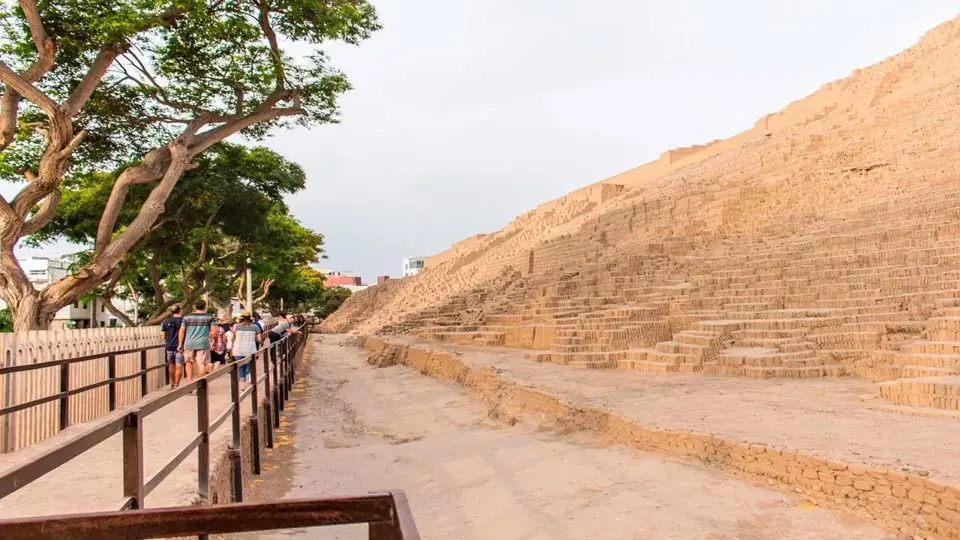
When one thinks of Lima, one usually imagines a coastal city overlooking the Pacific, top-notch gastronomy, or colorful neighborhoods with interesting stories.
But there is something that surprises everyone, including the most experienced travelers: in the middle of such a modern city, surrounded by buildings, Michelin-starred restaurants, emblematic cafes, and huge avenues, rises a pre-Columbian adobe pyramid that seems taken from another time. We are talking about Huaca Pucllana, one of the most fascinating archaeological sites in the Peruvian capital, and an unmissable visit for those wanting to understand the deep history of Peru without going far. Knowing how to visit Huaca Pucllana in Lima is much more than locating it on the map. It is discovering its history, understanding why it was so important for pre-Hispanic cultures, and choosing the best way to tour it to make the most of it. And if on top of that you can combine it with another key archaeological complex in the city, like Mateo Salado, the experience becomes even more complete.
Below we are going to review everything you need to know to know this unique landmark on the continent. You will also find tour and excursion options in Lima to complement your visit.
What is Huaca Pucllana: History and Curious Facts
Huaca Pucllana is an ancient pre-Columbian ceremonial center built by the Lima culture between 450 and 650 AD. It is located right in the district of Miraflores, one of the most touristic and modern in the Peruvian capital, generating a striking contrast between past and present.
This archaeological site was built entirely of adobe and is characterized by a great stepped pyramid, squares, patios, and ceremonial enclosures that fulfilled religious, administrative, and social functions. For centuries, it was a sacred space where rituals and ceremonies linked to the worldview of cultures inhabiting the central coast of Peru were performed. Over time, the huaca was occupied by different cultures, including the Wari and the Ychsma, until the arrival of the Incas. Then, for many years, the site was abandoned and even suffered inappropriate uses, until in 1981 recovery, research, and enhancement works began, allowing the rescue of this unique cultural heritage.
Today, Huaca Pucllana is one of Lima's main archaeological attractions and a symbol of how millennial history coexists with the contemporary city.
How to Visit Huaca Pucllana in Miraflores
Although it is possible to visit Huaca Pucllana independently, doing so through an organized excursion has clear advantages. First, you have a guide who interprets the site, explains its history, and helps you read the archaeological landscape with different eyes. Second, you gain comfort and tranquility. You don't have to worry about times, transport, or organization. You simply dedicate yourself to enjoying, learning, and taking photos.
In this sense, the excursion to Huaca Pucllana and the Mateo Salado Archaeological Complex is an excellent option, as it not only includes the visit to one of Miraflores' archaeological icons but also adds another fundamental site to understand Lima's pre-Hispanic history. The tour includes transfer, guided visit, and the accompaniment of specialists explaining each site clearly and dynamically. In addition, being an organized excursion, times are optimized and the stress of moving on your own is avoided, something very valued when traveling and wanting to enjoy without complications.
Where is Huaca Pucllana and How to Get There
One of the great points in favor of this site is its location. Huaca Pucllana is in Miraflores, a neighborhood very accessible from any point in Lima. This makes visiting it simple, even if staying in another neighborhood, or even if having little time in the city. If you are staying in Miraflores you can arrive walking, by taxi, or bus. Otherwise, you can hire private transport from other districts.
But believe us, being inserted within the city, it is not necessary to plan a full-day excursion just for the transfer, which makes it an ideal option to add history and culture to your urban itinerary.
The Huaca Pucllana Site Museum: The Perfect Prelude
Inside the archaeological complex is the Pucllana Site Museum, a key space to contextualize the visit. The museum exhibits pieces found during archaeological excavations, such as ceramics, textiles, and ritual objects helping to understand how ancient Lima cultures lived.
In addition, the museum explains the site's research and restoration process, allowing appreciation of the enormous work done to conserve the huaca amidst urban growth. Touring the museum before or after walking through the ruins makes the experience much more complete and meaningful.
Mateo Salado: Another Archaeological Treasure in the City
You read that right: in the excursion we offer we also add the visit to the Mateo Salado Archaeological Complex, which is one of the most important pre-Hispanic sets in Lima and complements perfectly. It consists of several adobe pyramids and was an administrative and ceremonial center of great relevance.
Like Pucllana, Mateo Salado was occupied by different cultures over time and is part of the archaeological legacy demonstrating that Lima was a key territory long before the arrival of the Spaniards. Visiting both sites in the same excursion allows comparing architectural styles, functions, and historical contexts, enriching the cultural experience. Furthermore, Mateo Salado was also recovered and enhanced, making it another example of the conservation work of Peruvian archaeological heritage within the city.
Published by Has Chacon on 08/06/2026